Research Conferences
Some of our members are involved in research here on campus. Read to see what they are studying and presenting!

Kaitlyn Johnson
URCA & SEPA
ACEs and Substance Use in Young Adults
Research Goals/Findings:
Specific Aim 1: Investigate the correlation between Adverse Childhood Experiences (ACEs), other experiences, and substance use among adults aged 18 to 25.
Specific Aim 2: Explore the moderating influence of socioeconomic status (SES) and rates of depression on the relationship between ACEs and substance use.
Specific Aim 3: Examine whether the predominant type of substance use varies based on family socioeconomic status (SES).
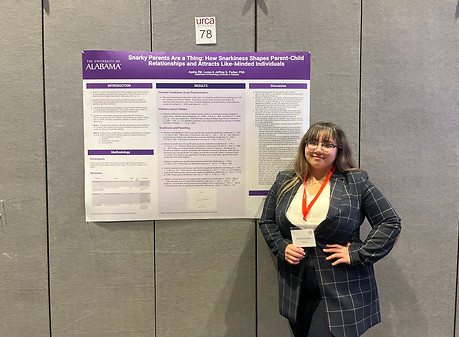
Aysha Lucas
URCA
Snarky Parents Are a Thing: How Snarkiness Shapes Parent-Child Relationships and Attracts Like-Minded Individuals
Research Goals/Findings:
This study explores parental snarkiness, a sarcastic or mocking communication style used in parenting, and its relationship with broader parenting styles (psychological control, warmth, autonomy granting, and involvement.) Findings revealed that snark is commonly used by both mothers and fathers, with psychological control strongly linked to its use. Warm mothers used less snark, while warm fathers were more snarky towards sons. On the other hand, cold fathers were more likely to use snark with their daughters. Parents who encouraged autonomy were less snarky, and involvement was not significantly related to snarky parents. The newly developed measure proved reliable and can now be utilized to measure parental snark. These findings highlight that snarkiness is a measurable aspect of parenting that may shape adolescent communication, relationships, and mental health!
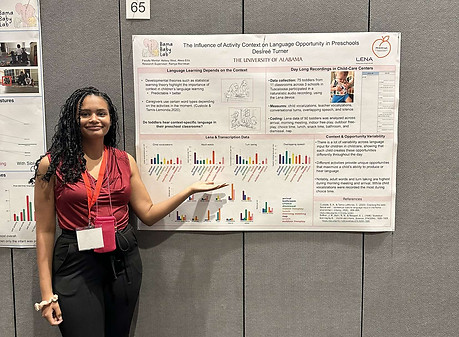
Desireé Turner
URCA
The influence of activity context on language opportunity in preschools
Research Goals/Findings:
Children learn language best when their language learning environment is predictable. We know this is true for the home but is statistical learning present in childcare centers? There is a lot of variability across language input for children in childcare, showing that each child creates these opportunities differently throughout the day. Different activities provide unique opportunities that maximize a child’s ability to produce or hear language as well as types of words for them to hear!

Sawyer May
URCA
Schizophrenia Evidence and Perceptions of Criminal Culpability and Responsibility
Research Goals/Findings:
We investigated how prospective jurors’ perceptions of a schizophrenic criminal defendant’s culpability and responsibility depending on how information regarding their condition was presented. Groups were presented with a vignette about an assault, expert testimony from a neuropsychologist, and a neuroimage detailing the differences between a brain affected by schizophrenia and a healthy control. Ultimately, we did not find any significant differences between groups.
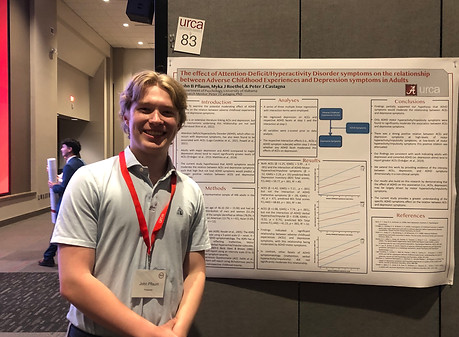
Jack Pflaum
URCA
The Effect of Attention-Deficit/Hyperactivity Disorder on the Relationship Between Adverse Childhood Experiences and Depressive Symptoms in Adults
Research Goals/Findings:
Studied the potential moderating effects ADHD symptoms have on the relationship between Adverse Childhood Experiences (ACEs) and depression in adults. Found that Motor hyperactive/impulsive symptoms (fidgeting, restlessness, etc.) predicted a stronger positive relationship between ACEs and depression.
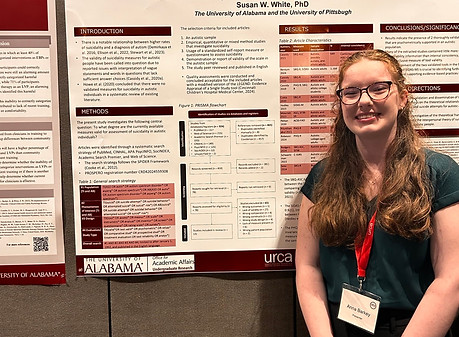
Anna Barkey
URCA
A Systematic Review of Suicidality measures for Autistic People
Research Goals/Findings:
We conducted a systematic literature search for studies that use suicidality measures in an autistic sample. After title/abstract and full text screening of the articles gathered from the search, 13 articles met full inclusion criteria and demonstrated either good or poor psychometric qualities for suicidality measures. In our analysis, we found two measures, the SBQ-ASC and the SIDAS-M, that had good discriminant, convergent, content, and face validity. We reccomend dissimination and further research on the validity of these measures to evaluate suicidality in autistic people.

Reese Fitzgerald
URCA
Mapping Personal Finance Education
Research Goals/Findings:
This research project looks at personal finance education course offerings across the United States for 2024-2025. With the use of qualitative data and quantitive data, we found that only 5% of high schools in the country do not provide a financial education course. Other findings showed an increase in personal finance education requirements across high schools.

Doris Davis
URCA
A Transdisciplinary Analysis of Racism in The Rural American South
Research Goals/Findings:
This research used both phenomenology and hermeneutics to explore the impacts of racism on mental health, specifically in southern, rural communities. As an ongoing project, this research lends itself to branch out in future directions, such as the impacts of living in socially segregated communities on children and adolescents of color, and whether the presence of prominent communities of color in those areas can mitigate the negative psychological impacts of racism.
Zoie Russell
URCA
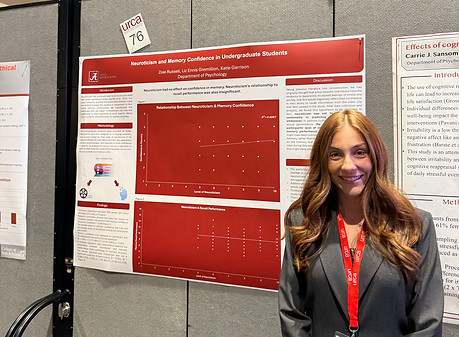
Neuroticism and Memory Confidence in Undergraduate Students
Research Goals/Findings:
We ran a multiple regression to analyze the relationship between neuroticism and memory confidence and memory recollection performance. Our data suggested that the relationship between neuroticism and memory confidence was not significant. Additionally, that the relationship between memory confidence and actual memory recollection performance was also not significant. This tells us that neuroticism does not have an effect on memory confidence or on memory recollection. In other words, if an individual scores higher (10) or lower (1) in neuroticism that this does not predict whether or not they will score any higher (5) or lower (1) in memory confidence, or perform any better or any worse on actual memory recollection.
Dylan Martin
URCA
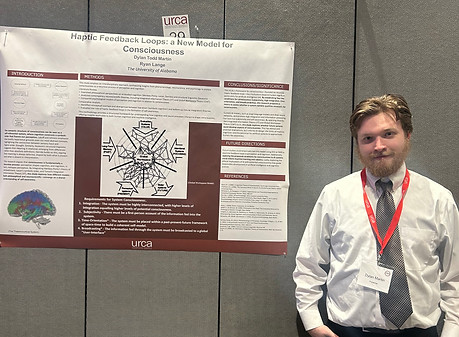
The Haptic Feedback Loop: A New Model for Consciousness
Research Goals/Findings:
•synthesis of top-down and bottom-up theories of consciousness.
•emphasis on the necessity of embodiment for conscious experience.
•requirements for system consciousness.

Julianna Correa
URCA
Associations between Theory of Mind and Emotion Skills in Young Children
Research Goals/Findings:
After conducting a secondary analysis of 311 preschool children, emotional knowledge shows correlation was with positive theory of mind score over and above age and vocabulary.